Feeds RSS
Showing posts with label Learning. Show all posts

Thursday, June 23, 2011

Improve Your Child’s Reading Habits with The Help of Ebooks

In this age of video games, any opportunity for learning should not be left out and reading through ebooks is an excellent way for beginning readers to learn and fully develop their reading and comprehension skills.
Kindle Wireless Reading Device, Free 3G, 6" Display, White - 2nd Generation
A lot of people are aware that ebooks exist but are still wary of using them, especially in child learning activities. If you have not taken advantage of this technological tool, you may be missing out on a lot because ebooks can actually facilitate a young child’s involvement with the reading and the literary arts.


Some who have tried sitting down with a toddler to read to him or her a book such as Treasure Island have struggled and experienced some resistance from the child especially after a few minutes.
Free Childrens Books and Young Adult Books for Kindle: Linked List of Over 1,000 Free Classics For Boys, Girls and Teens (Free Kindle eBooks)

However, if you were to obtain the ebook version of Treasure Island, it may even have cool background music and images that help add an improved sensory experience to it.
V.Reader Animated E-Book System - Pink
Several ebooks have an audio option that reads the story page by page. Some have icons that can help kids learn about phonics and intonations.


A lot of children diagnosed with attention deficit disorder have improved their attention ability with the use of ebooks. Most children who have difficulty paying attention to a regular printed book becomes interested in reading when done at a computer or other multimedia device or an ebook reader such as a Kindle, iPad, Sony Reader, etc.
The Adventures of Tom Sawyer (Complete) with illustrations and a FREE audiobook

To many children, reading a standard printed book is a passive and mundane activity but clicking a mouse to flip to another page or clicking on pictures and icons is practically more dynamic.

It is an accepted fact that there are children who are just resistant to reading. They simply do not want anything to do with sitting down and reading a book and they won’t even let you read one to them.

If this is your dilemma as a parent, try an ebook! If you select ebooks that are of good quality, kid friendly, and not boring, you may just discover you have a zealous reader on your hands. Images and sound can really liven up almost any book. You can even find free ebooks you can download on your ebook reader from dozens of sites online. Kindle has versions for the handheld device and for the PC. I have the Kindle for PC version installed on my child’s computer which automatically stores the ebooks I download for them, ready for reading as needed.
National Geographic Kids
Because of the availability of ebooks, the presently out-of-print classic books can now be read in digital formats.

In this age of video games, any opportunity for learning should not be left out and reading through ebooks is an excellent way for beginning readers to learn and fully develop their reading and comprehension skills.

Protected by Copyscape Duplicate Content Detection Software

Friday, June 17, 2011

Nurturing Your Child's Creativity

 Creativity is not measured by intelligence tests, and experts disagree concerning the relationship between intelligence and creativity.  Most of them agree, however, that an individual’s intelligence can determine the quality of the creativity.  But a study at Donald MacKinnon at the Institute of Personality Research found a high degree of self-acceptance and confidence, sheer energy, and a whole-hearted commitment to the chosen task as being more consistent than intelligence in highly creative individuals.

Creative children have certain traits in common at a young age.  Can you observe any of these traits in your child?
IQ Baby Knock-Knock Blocks
Is your child very curious?
“How do frogs hop?” “What makes a rainbow?” “Why is cotton soft?”  Some adults may find such questions bothersome, but curiosity is an essential ingredient of creativity as children constantly try to make sense of their world.
Does your child’s play reflect imagination?
Creative children invent new games with their playmates.  They act out fantasies and experiment a lot.  A playful, imaginative childhood is vital to the development of creativity.
 Alex Super Art Table with Paper Roll and Two Benches
Does your child use analogy in speech?
The use of analogy to express a thought clearly shows a direct expression of creativity in language.  It is similar to seeing dinosaur clouds or lollipop trees.
Educational Insights Set 1: Reading Readiness (Hot Dots Phonics Flash Cards)
Does your child challenge authority?
It is typical for four-year-olds to ask, “Why do I have to go to bed now and you don’t?” These children sometimes rationalize their behavior with what they see others in their life doing.
Creativity
Is your child intensely animated?
Sometimes a child’s eyes sparkle when describing a playground game.  He or she may wave his or her hands and the cheeks may appear flushed.
Brand New Arc Media Inc. Paper Activities Coloring Workshop Creativity Projects For Children
Creative children become very involved in their current project or game.  They are eager to tell of their discoveries, and during conversations they often rush on to complete sentences for others.
Does you child like to guess outcomes?
Creative children like to guess the ending to the story or the movie.  Before they complete an experiment, they are usually confident of the outcome.  The fun of doing an activity such as drawing dot-to-dot is in predicting what the completed picture will be.  But being wrong leaves them undaunted and eager for more.
 JumpStart Artist


Thursday, June 16, 2011

How Learning Takes Place

Learning is central to activities the in the home, in school, and in everyday life. It is a complex process which takes place in the brain. The human brain is considered a frontier in the educational explorations today. However, every parent and every teacher searches for the best road – the most effective way to learning. The important question therefore is: How do people learn? What are the most effective and the fastest method of learning, especially for children?
Our WORST Homeschool Mistakes (and how YOU can avoid them!) (Easy Homeschooling)
There are certain methods by which people learn.

Trial and Error
Learning through trial and error comes as a result of hitting and missing. One learns how to sew by different ways of putting fabric together. Some people call this procedure learning by experience. If a child would learn how to swim by this method, it might be risky if not fatal!

Conditioning
This learning method, labeled by psychologists as conditioning is habit-forming way—learning to do something by getting used to it. This, too, has objections, as not all practice makes perfect. One may play a piece on the piano over and over again, but that’s no guarantee that it’s being done right. The point is, if you have to practice and repeat something, you have to do it the right way, or else the brain will be conditioned to do the wrong thing because of the repetitive mistake.
Home Learning Year by Year: How to Design a Homeschool Curriculum from Preschool Through High School
Insight
This happens when a sudden flash of intellect brings on an answer or a solution to a problem. Archimedes, the Greek mathematician and inventor, was believed to have discovered the buoyancy principle in this manner. The answer to the great riddle of the crown asked him by the king of Syracuse came while he was taking a bath. So excited was he that he ran into the street without dressing and yelled, “Eureka!” (I’ve found it!)

Operational though these methods may be, they’re not foolproof guarantees of learning. However, there’s only one sure way in which children can and will learn, whether we like it or not and whether they like it or not. Psychologists agree on this method.

Modeling
It is learning by example, observation, and imitation, or identification. In teaching music to very young children, this effective method is called “learning by rote” (or imitation). While scientific studies are continuously being done in this field, there is voluminous research evidence on the effectiveness of this approach.


Thursday, May 26, 2011

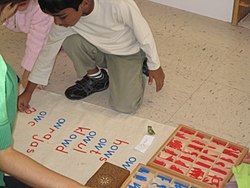
Montessori Style of Homeschooling

Formulated from the work of Dr. Maria Montessori, this manner of teaching aims to replicate natural laws that a child encounters in life.


Hence the aim of the teacher is to contain the surroundings and not the child.  Studies have shown that children who are allowed to interact with their environment built up an innate self-discipline, love for order and raw curiosity.

The Montessori technique of teaching is particularly suitable to the preschooler who wishes to do everything by himself. Looking for ways in which your kid can take part in the cleaning, gardening, washing, cooking, and other ‘grownup’ activities arranges the perfect background for the learning experience. By catering such opportunities for independence, the child’s self-regard also gets a large boost.

Cultural, artistic and scientific activities abound in the Montessori thirty to six class. There’s no junk food, TV or computer. Material is picked out carefully. The child is never forced to work. Rather he is encouraged to do things that matter to him, and the teacher picks up the teaching from cues presented by the child.  The Montessori process centers on the child’s inborn ability to learn from his environment. Hence the teacher aims to promote the natural curiosity of the child. He is never coerced to learn or explore. When the child realizes why he needs to learn something, he will like the learning process.


Protected by Copyscape Web Plagiarism Finder

Tuesday, May 17, 2011

Tips on Homeschooling a Child with Disability

image credit

If your your child has been diagnosed or is presently suffering from a disability that severely hinders his ability to adhere to a regular school routine, then homeschooling is your better choice.

The child will be always under close guidance would still be getting a lot of quality education, despite the disability. This is greatly beneficial especially to your child, considering how kids with disabilities are branded in public schools.

Goal setting is a crucial part of homeschooling a child that has a disability. Arrange the length of working hours in a week for the child. A child having a disability might experience some bad days. Therefore, the schedules of the learning hours will be adjusted according to the interests and needs of the child. The computer and the internet plays a large role in this process. In this manner, he will have all the essential information at his fingertips while staying within the confines of the home.

Field trips and extra educational activities are just as significant. Get some help from your support group. Visit locations of interest and interact with other homeschooled kids in the group. Take your child out for a few activities, for purposes of face to face and physical socialization. This will assist in fortifying your child’s self-esteem.

Most importantly, keep in mind that the basic principles of homeschooling are generally the same, even if your child is suffering from a disability. You’ll just have to seek the right opportunities and the most comfortable alternatives to accomplish equivalent goals.
Copyright © 2011 Athena Goodlight  


Tips on Homeschooling Teenage Children

As children mature and become young adults, parents feel speculative about homeschooling.

A lot of parents then break the homeschooling process and merrily turn in the reign to outside authorities. But is this actually necessary? Is the purely compartmentalized education system offered in traditional schools the best option?

When the growing burden of a few of the higher level Math or Science appears to be beyond you, draft the help of somebody who knows a lot. You will be able to even swap your own services and so save some money. With homeschooling going more and more popular, support groups would have countless resources that help you locate the proper teacher for your child.

The fundamental principle that guides homeschooling is this: any child has the inherent capability to grow, develop and accomplish its full potential. All it requires is the correct environment and all the correct answers. Be there to give these and think doubly before you turn over this obligation to a third party.

Copyright © 2011 Athena Goodlight

Protected by Copyscape Website Copyright Protection

How to be an Effective Homeschool Teacher

The success of imparting knowledge lies greatly in the hands of the teacher. In most homeschooling situations, the teacher is a close relative or a parent.

In a few cases, parents might split up the subjects between them. Seldom, if both parents are busy, they might hire a homeschool teacher. Whatsoever the case, children require time with their parents. Parents, as a rule, make up very good teachers.

Teaching doesn’t require a clinical demonstration of facts. Learning has to be structured lovingly into daily life with the interest of the child in mind. That’s where parents come into the picture. Grandparents also make fine teachers, particularly since they possess an abundance of patience.

If you feel uneasy about your knowledge or skill, relax. There are plenty homeschooling resources that are directed at aiding you. Professional curriculum bundles, support groups, virtual schools, online help desks and library resources are all in hand. When you begin, you would like to capitalize on the commercial curriculum packages. Readymade software package also allows for you to record and log crucial accomplishments.

Local support groups are a great source of help, materials and ideas. This is where you have the chance to meet seasoned homeschoolers, who would be more than willing to offer their perceptiveness and advice. Once you fall into the homeschooling routine, you’ll find yourself tailor-fitting the curriculum to befit your own needs.


Copyright © 2011 Athena Goodlight

Protected by Copyscape Website Copyright Protection